
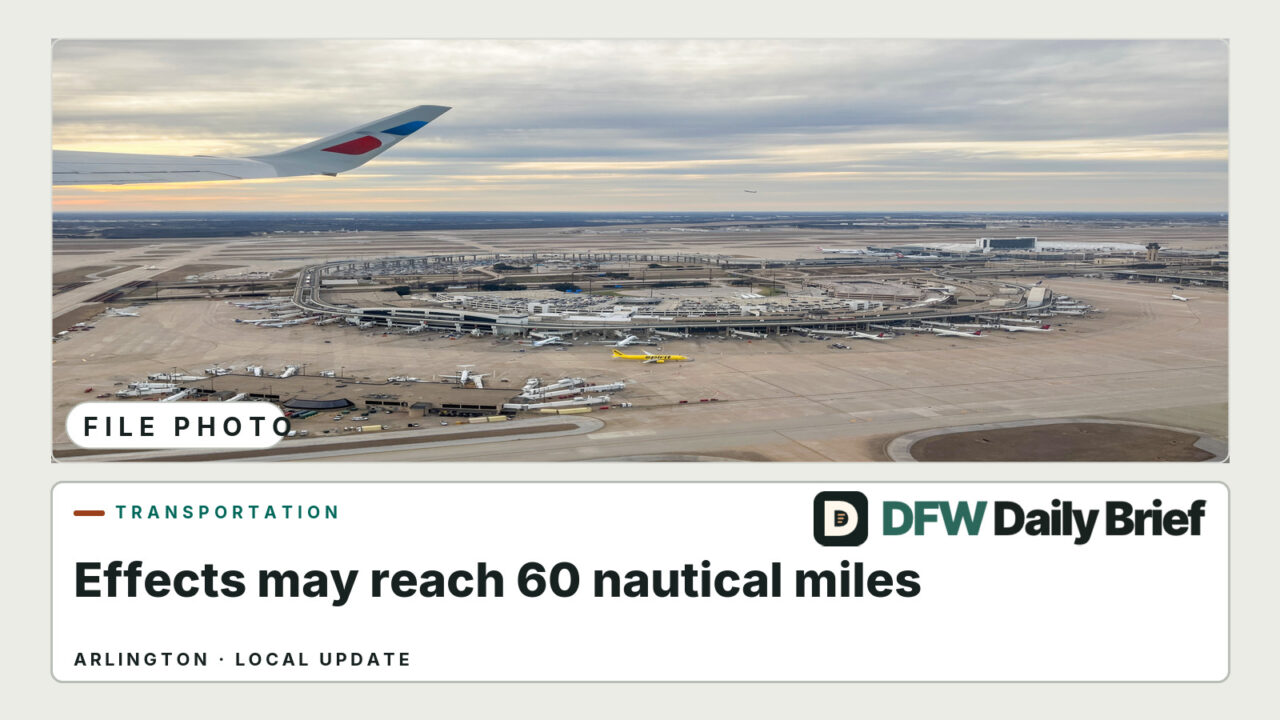
The Federal Aviation Administration expects heavy aviation volume around the July 14 World Cup semifinal in Arlington, with special procedures directly covering 13 airports across North Texas.
The FAA’s event notice for the Dallas-Fort Worth Metroplex reaches well beyond the airport most travelers use for airline service. It warns of possible effects for commercial traffic, private and charter aircraft, and routine training operations across the region.
The notice does not say that every flight will be delayed. It does identify the July 14 demand level as heavy and lays out possible holding, routing, clearance and operating constraints during peak periods.
The 13 airports directly covered
The FAA procedures name major commercial airports, reliever airports, municipal fields and a military installation. The full list is:
- Dallas Fort Worth International Airport
- Dallas Love Field
- Perot Field Fort Worth Alliance Airport
- Fort Worth Spinks Airport
- Addison Airport
- Dallas Executive Airport
- Grand Prairie Municipal Airport
- Arlington Municipal Airport
- Mesquite Metro Airport
- Naval Air Station Joint Reserve Base Fort Worth
- McKinney National Airport
- Denton Enterprise Airport
- Fort Worth Meacham International Airport
That geographic spread is the key local consequence in the official record. The aviation plan is not confined to Arlington or to the airspace immediately around the match site. It directly includes airports across Dallas, Fort Worth and several surrounding communities.
The FAA also says airports within 60 nautical miles of DFW International may experience substantial traffic increases. At those surrounding airports, parking may be unavailable and visiting aircraft may face tighter requirements, even if an airport is not among the 13 named facilities.
What airline passengers should understand
For people flying commercially through DFW International or Dallas Love Field, the notice is a warning about potential operational pressure, not a prediction that a particular departure or arrival will be late.
The FAA says instrument-flight-rules arrivals may encounter airborne holding or routing changes. Departures may receive assigned clearance times. Those measures are tools for handling demand when traffic rises, but the notice does not identify which airline flights, if any, will experience them.
Passengers should therefore separate a regional traffic classification from an individual flight status. “Heavy” describes the volume anticipated for the event. It does not mean every flight at both commercial airports will be disrupted.
The practical step supported by the notice is to check current airport and flight information rather than assuming normal timing or a certain delay. Conditions can differ by airport, time and operation, and the special procedures provide a regional framework rather than a passenger-by-passenger forecast.
Private and charter operators face broader planning issues
The official notice has more direct operational detail for general aviation. Visiting aircraft may encounter unavailable parking or tighter airport requirements as demand rises at fields near DFW.
That makes the 13-airport list only the starting point for planning. The FAA’s 60-nautical-mile warning means an operator cannot assume a nearby airport will have space or ordinary access simply because it is outside the directly listed group.
Operators should check current airport information and notices to air missions, commonly called NOTAMs, for the airport and time they intend to use. The FAA record supports checking current conditions; it does not support assuming that parking, access or a preferred routing will be available.
For flights operating under instrument flight rules, the stated possibilities include airborne holding, changed routes and departure-clearance times. Each can affect how an operator plans, but none is certain for every flight.
The notice also says the special procedures can apply on match day and one or two days before or after it. July 14 is the event date, but operators should not treat the aviation effects as limited to the hours immediately surrounding the semifinal.
VFR flying and training may be especially constrained
The FAA warns visual-flight-rules operators of potentially lengthy delays during peak periods. It also identifies severe limits that may affect practice approaches, touch-and-go operations, flight following and training activity.
Those details make the notice particularly relevant to flight schools and pilots planning routine proficiency work. A training operation that is normally local and repetitive still uses capacity, and the FAA is explicitly warning that several common activities may be severely limited when event traffic peaks.
The listed constraints do not amount to a blanket statement that all VFR or training flights are prohibited. They do mean pilots and schools should check current conditions and avoid assuming that normal practice activity will be accommodated.
Flight following is among the services the FAA says may face severe limits. Practice approaches and touch-and-goes are also singled out. Those are more specific consequences than a general warning about busy airspace and show why the notice matters even to pilots who are not transporting match visitors.
Why the timing may extend beyond July 14
Large-event aviation demand is not necessarily confined to the start and finish of the event itself. The FAA notice allows for special procedures on the match date and during one or two days on either side.
That window matters differently for each audience. An airline passenger could encounter changed traffic-management conditions on a travel day near the match. A charter operator may need to confirm parking and airport requirements before bringing an aircraft into the region. A flight school may find that routine VFR work faces delays or severe operating limits during a peak period.
The notice supports all three cautions, but it does not guarantee any one outcome. It does not establish that an airline will cancel a flight, that a named airport will run out of parking or that every training operation will be curtailed.
A regional aviation event, not just an Arlington issue
The most important detail in the FAA record is its scale. Thirteen airports are directly covered, and other airports within 60 nautical miles of DFW may also see substantial increases in traffic.
For commercial travelers, that means monitoring current information without presuming a delay. For private and charter operators, it means confirming parking, requirements, routing and current NOTAMs. For flight schools and VFR pilots, it means accounting for potentially lengthy delays and severe limits on several routine activities.
The July 14 semifinal is in Arlington, but its aviation footprint may reach across the Dallas-Fort Worth region and into the days around the match. The FAA’s heavy-volume classification is a planning signal, not a promise that disruption will occur on any specific flight.